
Battersea Break-Ins: Where They Happen, and How to Lock Them Out
Battersea break-ins are more common than most residents think. Battersea feels like one of the safer corners of south west London, and in most ways it is, but burglary is the one crime where the numbers tell a less comforting story, and as a local locksmith we see the aftermath most weeks. Here is what the real data says about Battersea break-ins across SW11 and SW8, where they tend to cluster, how burglars actually get in, and the specific locks that stop them.
How common are Battersea break-ins, really?
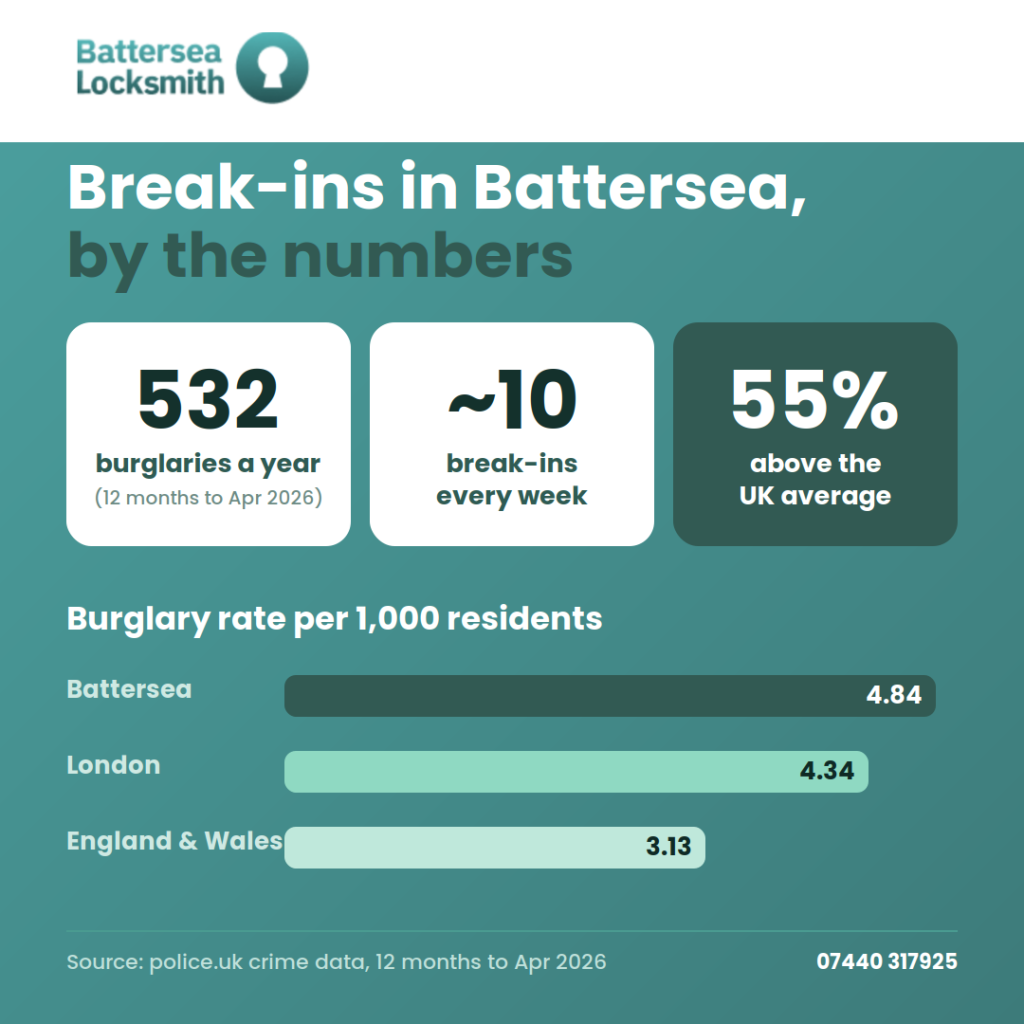
According to police.uk crime data, Battersea recorded around 532 burglaries in the 12 months to April 2026. That is roughly 10 break-ins every week, or about 44 a month.
Here is the part most locals do not realise: Battersea’s burglary rate works out at about 4.84 per 1,000 residents, roughly 55% higher than the national average of 3.13, and it even runs above the London-wide rate of 4.34. That is despite Wandsworth being one of the ten safest boroughs in London overall. Burglary is simply the exception to Battersea’s otherwise reassuring crime picture.
The national trend is actually downwards (burglary across England and Wales fell about 8% year on year), so this is a good moment to make sure your own door is not the easy one on the street.
Where break-ins cluster in SW11 and SW8
Burglary is never evenly spread, and in Battersea it tends to concentrate in a few predictable places: the busier through-roads and the streets backing onto them around Battersea Park Road and Queenstown, the denser terraced streets off Lavender Hill and towards Clapham Junction, and the mix of flats and conversions across Latchmere and Northcote. The eastern edge towards Nine Elms and the Power Station (which sits across SW11 and SW8) has its own pattern, with communal entrances and new-build flats as the weak points rather than individual front doors.
If you want to check your own street, police.uk lets you search any postcode for recent recorded crime. The honest takeaway is that no part of Battersea is immune, but a well-locked door moves you off the “easy target” list wherever you live. If you are in a flat around Nine Elms and the Power Station, the communal and front-door setup matters as much as your own lock.
How burglars actually get in
This is where most people guess wrong. Burglars are not master lock-pickers climbing through skylights. The national picture from the ONS Crime Survey for England and Wales is blunt:
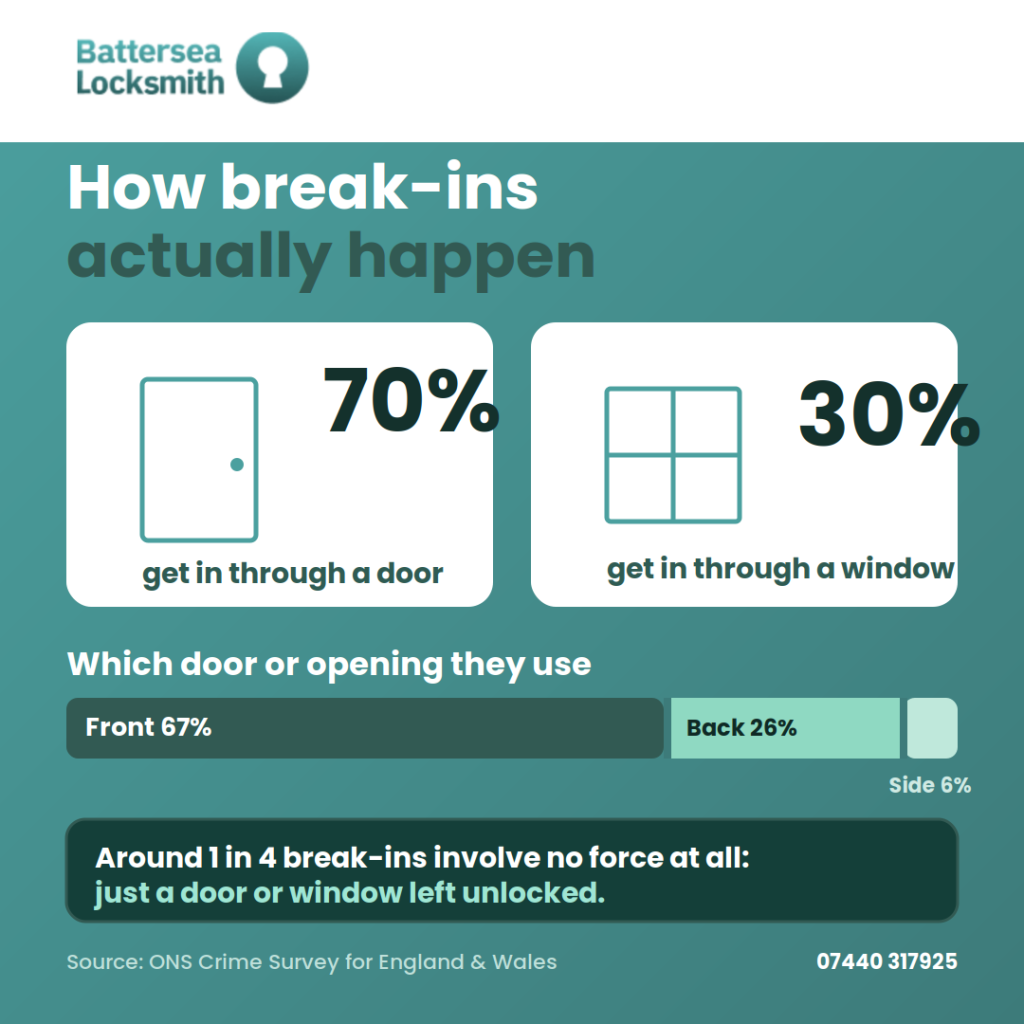
- When a burglar gets inside, they come through a door about 70% of the time, and a window about 30%.
- The front door is the single most common way in (about 67%), with the back door around 26% and the side just 6%.
- And the one that should change how you leave the house: around 1 in 4 break-ins involve no force at all, just a door or window that was left unlocked.
In other words, your front door and the cylinder in it are the thing that decides whether you are an easy target. If you have ever come home to a lock that feels loose, sticky or has been tampered with, get it looked at, because a worn or damaged lock is an open invitation. We cover that under our work to repair a damaged lock.
Lock them out: a Battersea door-by-door guide
Battersea’s housing splits into a few types, and each needs a slightly different lock to shut burglars out. Here is what actually works.
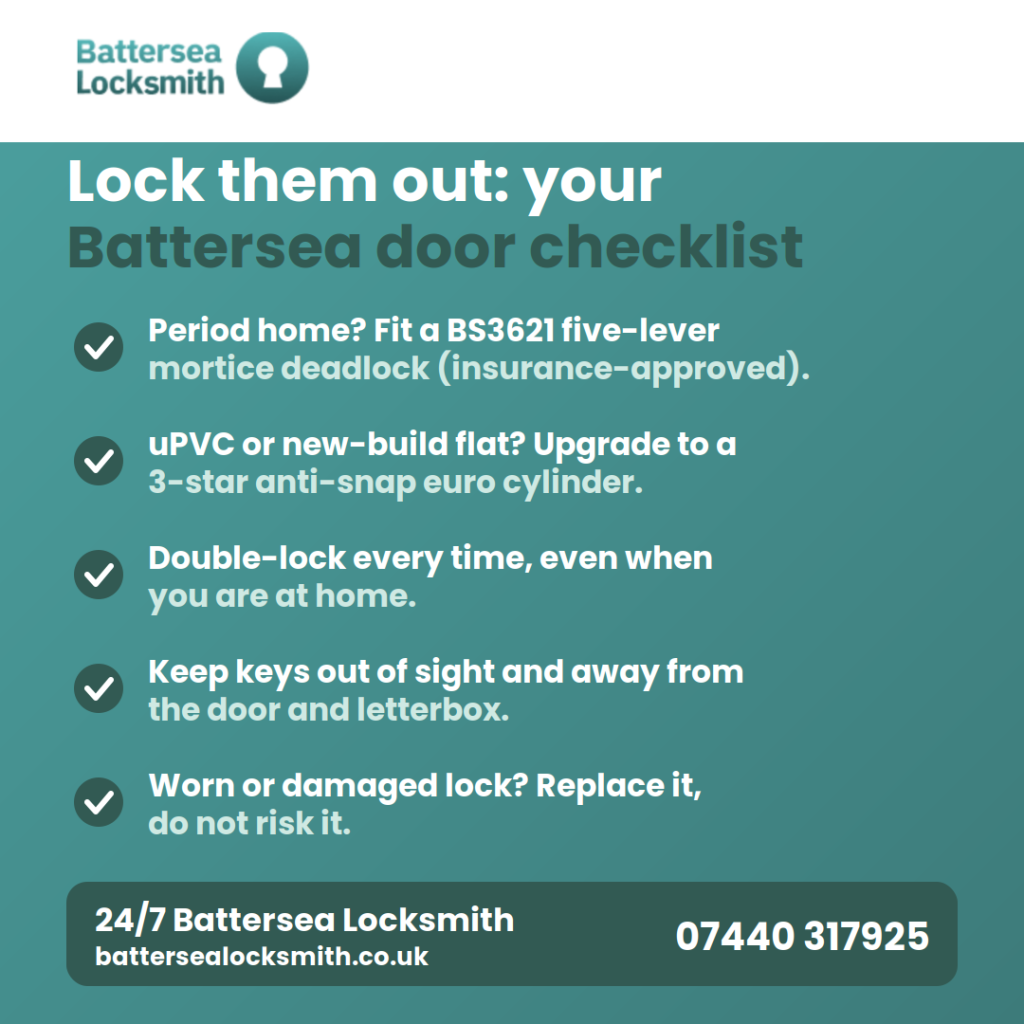
Period homes (Victorian and Edwardian terraces and conversions). Your main exit door should carry a British Standard BS3621 five-lever mortice deadlock, which is also what most insurers require. Many of these homes also run a nightlatch and deadlock pairing, which is exactly where Banham locks are so common across the area. If your current setup is tired or below standard, it is worth a lock change in Battersea before the dark evenings.
uPVC and composite doors, and new-build flats. The weak point here is the euro cylinder, which cheaper versions can be “snapped” in seconds. Upgrading to a 3-star anti-snap cylinder is the single best-value security improvement you can make. This matters most across the new-build and luxury flats around Nine Elms and the Power Station.
Everyone, whatever your door. Double-lock it every time, even when you are home (remember, a quarter of break-ins are through unlocked doors). Keep keys out of sight and well away from the letterbox, and never leave a spare in an obvious spot.
If you are not sure what is fitted or whether it meets your insurance policy, a locksmith in SW11 can check it in a few minutes.
Already been targeted, or your lock is damaged?
If you have had an attempted break-in, a snapped cylinder, a broken key in the lock, or you have been locked out, do not leave the door insecure overnight. Our emergency locksmith team covers Battersea around the clock and can make your home secure again fast, usually within about 30 minutes.
Call Battersea Locksmith any time on 07440 317925.
Sources
- Burglary counts and rates for Battersea, Wandsworth and London: police.uk / data.police.uk, 12 months ending April 2026. Street-level police data is published with roughly a three-month lag.
- National burglary totals and trend: data.police.uk, 2026.
- Point and method of entry (door vs window, front/back/side, unlocked entry): ONS Crime Survey for England and Wales, Nature of Crime: burglary dataset.
Figures are the latest available at the time of writing and are recorded crime only; actual numbers may be higher.